
MD5, SHA1, SHA256 Hash Cracking: Complete Guide for Pentesters
Everything you need to know about cracking password hashes in 2026. From understanding hash algorithms to choosing the right cracking method, this guide covers MD5, SHA1,SHA256, and beyond for penetration testers and security researchers.
Hash cracking is a fundamental skill for penetration testers. Whether you've extracted password hashes from a compromised database, captured NTLM hashes during a network assessment, or recovered hashed credentials from configuration files, knowing how to efficiently recover the plaintext passwords is essential for demonstrating impact and continuing your assessment.
Understanding Password Hashing
Before diving into cracking techniques, let's understand why passwords are hashed in the first place. When you create an account on a website, your password shouldn't be stored in plaintext. Instead, it's run through a cryptographic hash function that produces a fixed-length string of characters.
Hash functions are designed to be one-way: easy to compute in one direction but computationally infeasible to reverse. When you log in, the system hashes your input and compares it to the stored hash — it never needs to know your actual password.
Key Properties of Hash Functions
- Deterministic - Same input always produces the same output
- Fixed output length - Regardless of input size, output is always the same length
- Avalanche effect - Small input changes produce drastically different outputs
- Pre-image resistance - Given a hash, it should be infeasible to find the original input
- Collision resistance - It should be infeasible to find two inputs with the same hash
Common Hash Types Explained
Different systems use different hashing algorithms. Recognizing the hash type is the first step in any cracking attempt. Here are the most common ones you'll encounter during penetration tests.
MD5 (Message Digest 5)
MD5 produces a 128-bit (32 character hex) hash. Despite being cryptographically broken, it's still widely used in legacy systems.
- Length: 32 hexadecimal characters
- Example:
5f4dcc3b5aa765d61d8327deb882cf99 - Status: Cryptographically broken, fast to crack
SHA1 (Secure Hash Algorithm 1)
SHA1 produces a 160-bit (40 character hex) hash. Also considered insecure for cryptographic purposes but still found in many applications.
- Length: 40 hexadecimal characters
- Example:
5baa61e4c9b93f3f0682250b6cf8331b7ee68fd8 - Status: Deprecated, collisions demonstrated
SHA256 (SHA-2 Family)
SHA256 produces a 256-bit (64 character hex) hash. Part of the SHA-2 family, it's currently considered secure and widely adopted.
- Length: 64 hexadecimal characters
- Example:
5e884898da28047d9165...a1b4c8fcbd - Status: Currently secure, slower to crack
SHA384 & SHA512
Larger variants of SHA-2 with 384-bit (96 char) and 512-bit (128 char) outputs respectively. More secure but also more computationally intensive.
MySQL Hashes
MySQL uses its own hash formats for password storage.
- MySQL3: 16 character hash (old, very weak)
- MySQL5: 40 character hash starting with * (e.g.,
*2470C0C06DEE42FD1618BB...)
bcrypt, scrypt, and Argon2
Modern password hashing algorithms designed specifically for password storage. They include built-in salting and are intentionally slow to resist brute-force attacks.
- bcrypt: Starts with
$2a$,$2b$, or$2y$ - Argon2: Winner of the Password Hashing Competition, starts with
$argon2
How to Identify Hash Types
Identifying the hash type is crucial before attempting to crack it. Here are the key indicators to look for.
By Length
- 16 chars — MySQL3, Half MD5
- 32 chars — MD5, NTLM, MD4
- 40 chars — SHA1, MySQL5 (with *)
- 64 chars — SHA256, SHA3-256
- 96 chars — SHA384
- 128 chars — SHA512, Whirlpool
By Prefix
$1$- MD5 (Unix crypt)$2a$,$2b$,$2y$- bcrypt$5$- SHA256 (Unix crypt)$6$- SHA512 (Unix crypt)*- MySQL5$argon2i$,$argon2id$- Argon2
Online Hash Identifiers
When in doubt, use hash identification tools. Tools like hashid, hash-identifier, or online services can analyze a hash and suggest possible algorithms.
Hash Cracking Methods Compared
There are several approaches to recovering plaintext from hashes. Each has its strengths and ideal use cases.
1. Dictionary Attacks
The most common approach. You hash each word in a wordlist and compare it to your target hash. Effective against weak passwords.
- Pros: Fast, effective against common passwords
- Cons: Only works if password is in the wordlist
- Best for: Common passwords, leaked password lists
2. Brute Force
Systematically try every possible combination of characters. Guaranteed to find the password eventually, but can take impossibly long for complex passwords.
- Pros: Will find any password given enough time
- Cons: Extremely slow for long/complex passwords
- Best for: Short passwords, known character sets
3. Rainbow Tables
Pre-computed tables of hash-to-plaintext mappings. Trade storage space for computation time. Extremely fast lookups but require massive storage.
- Pros: Very fast lookups, no computation needed
- Cons: Huge storage requirements, defeated by salting
- Best for: Unsalted hashes, legacy systems
4. Rule-Based Attacks
Apply transformation rules to dictionary words (e.g., capitalize first letter, add numbers, substitute characters). Dramatically expands coverage.
- Pros: Catches common password patterns (Password1!, p@ssw0rd)
- Cons: Slower than pure dictionary attacks
- Best for: Corporate environments, policy-compliant passwords
5. Online Dehash Services
Services that maintain massive databases of pre-cracked hashes. Simply submit your hash and get the plaintext instantly if it exists in their database.
- Pros: Instant results, no hardware needed, billions of hashes
- Cons: Only works for previously cracked passwords
- Best for: First-pass cracking, common passwords, bulk hash lists
Tools Overview: The Big Three
Let's compare the most popular tools for password hash cracking.
Hashcat
The world's fastest password recovery tool. Uses GPU acceleration to achieve incredible speeds. Supports 300+ hash types.
- Speed: Billions of hashes/second with modern GPUs
- Requirements: Powerful GPU (NVIDIA/AMD), significant power consumption
- Learning curve: Moderate to steep
- Cost: Free software, but requires expensive hardware
John the Ripper
Classic password cracker with excellent format detection. CPU-based by default but supports OpenCL GPU acceleration.
- Speed: Slower than Hashcat on GPUs, competitive on CPUs
- Requirements: Runs on any hardware
- Learning curve: Moderate
- Best feature: Automatic hash type detection
Online Dehashers (HPlus, etc.)
Cloud-based services with massive pre-computed databases. No hardware required, instant results for known hashes.
- Speed: Instant lookup (milliseconds)
- Requirements: Internet connection only
- Learning curve: None
- Best feature: Billions of pre-cracked hashes available instantly
Speed Comparison: GPU vs Database Lookup
Let's put the performance differences in perspective with real-world scenarios.
Scenario: Cracking 10,000 MD5 Hashes
- Hashcat (RTX 4090): Hours to days, 60-80% success rate
- John the Ripper (CPU): Days to weeks, 50-70% success rate
- Rainbow Tables: Minutes, 40-60% success rate
- Online Dehasher (HPlus): 2 seconds, 70-85% success rate
Success rate depends on password complexity. Common passwords have higher rates.
The key insight: always start with a database lookup. If the password has ever been cracked before and added to a dehasher's database, you get instant results. Only fall back to GPU cracking for unique, never-before-seen hashes.
The Optimal Cracking Workflow
Professional pentesters follow a systematic approach to maximize success while minimizing time spent.
Step 1: Identify Hash Types
Sort your hashes by type. Different algorithms require different approaches and have different success rates.
Step 2: Online Lookup First
Submit all hashes to an online dehasher like HPlus. This takes seconds and will crack 70-85% of common passwords instantly. Why spend GPU hours on passwords that are already in a database?
Step 3: Dictionary Attack on Remaining
For hashes not found in step 2, run dictionary attacks with common wordlists (rockyou.txt, SecLists, etc.) and basic rules.
Step 4: Targeted Rule Attacks
Apply organization-specific rules based on password policies. If the target requires "8+ characters with uppercase and number," create rules targeting that pattern.
Step 5: Brute Force (If Justified)
Only brute force when you know the password is short or you've identified the character set. Full brute force of long passwords isn't practical.
Understanding Salted Hashes
Modern systems add a random string (salt) to passwords before hashing. This makes each hash unique even for identical passwords, defeating rainbow tables and pre-computed lookups.
- Without salt:
hash(password)- Same password = same hash - With salt:
hash(salt + password)- Same password = different hashes
For salted hashes, you must perform real-time computation. This is where GPU-based tools like Hashcat excel. Rainbow tables and simple database lookups won't work for properly salted hashes.
Legal and Ethical Considerations
Hash cracking is a powerful technique that must be used responsibly and legally.
- Authorization: Only crack hashes from systems you're authorized to test
- Scope: Ensure hash cracking is within the engagement scope
- Data handling: Securely store and transmit recovered credentials
- Reporting: Document cracked passwords properly in your report
- Disclosure: Never use recovered credentials outside the authorized scope
Unauthorized hash cracking can violate computer fraud laws in most jurisdictions. Always have written authorization before attempting to crack password hashes.
HPlus: 90 Billion Hashes at Your Fingertips
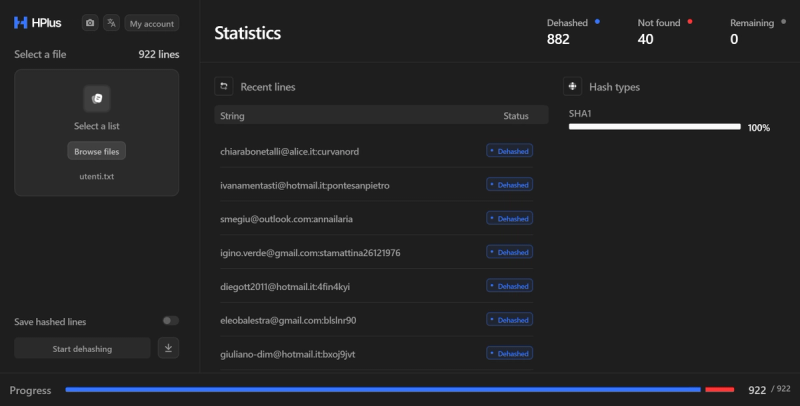
Why spend hours on GPU cracking when the password might already be in a database? HPlus is our dedicated dehasher with over 90 billion hashes and 8 billion unique passwords. It should be your first stop before firing up Hashcat.
- 90B+ hashes - One of the largest hash databases available
- 8B+ unique passwords - Sourced from breaches, wordlists, and cracking operations
- 11 hash types - MD5, SHA1, SHA256, SHA384, SHA512, MySQL3, MySQL5, and more
- 5,000 lines/second - Process bulk hash lists in seconds
- Weekly updates - Database continuously expanded with new cracked hashes
- No hardware required - Skip the $2000+ GPU investment
The smart workflow: run your hashes through HPlus first, crack 70-85% instantly, then only use GPU resources for the remaining unique hashes. You'll save hours of computation time on every engagement.
Quick Reference: Hash Type Cheat Sheet
- MD5 — 32 chars, Hashcat mode 0, Easy
- SHA1 — 40 chars, Hashcat mode 100, Easy
- SHA256 — 64 chars, Hashcat mode 1400, Medium
- SHA512 — 128 chars, Hashcat mode 1700, Medium
- MySQL5 — 40 chars (*), Hashcat mode 300, Easy
- NTLM — 32 chars, Hashcat mode 1000, Easy
- bcrypt — 60 chars ($2), Hashcat mode 3200, Hard
- Argon2 — Variable, Very Hard
Conclusion
Hash cracking is both an art and a science. The most effective pentesters don't just throw GPUs at the problem — they use a strategic approach that maximizes results while minimizing time and resources.
Remember the optimal workflow: identify your hash types, check online dehashers first for instant wins, then apply targeted attacks for the remaining hashes. This approach consistently delivers the best results in real-world penetration tests.
Whether you're cracking a single hash from a CTF or processing thousands of credentials from a database dump, understanding these fundamentals will make you a more effective security professional.
Shop nowThe blog posts on this website are fictional and theoretical. They exist for educational purposes only and should never be treated as instructions to perform illegal or unauthorized activities.
The scenarios described are hypothetical and do not promote or encourage malicious or harmful actions. They reflect a professional penetration tester's perspective, assuming proper permission and legal authorization to test a website, company, or network.
Our posts are not a call to action, and we do not condone illegal activity. Readers are responsible for complying with applicable laws and regulations.
By reading our posts, you acknowledge these terms. If you are not a professional or authorized individual, do not attempt to replicate any techniques described here.
Our content is for education only, and we strongly advise against using any information or techniques for malicious purposes.
Read next
Web Crawler vs Search Engine Scraper: Which One Should You Use?

Google Dorks for OSINT: An Advanced Research Guide
SQL Injection Methods Explained: Time, Boolean, Error, Union and More
Credential Stuffing and AntiPublic Checkers: What Security Professionals Need to Know

Google Dork Operators Cheat Sheet 2026: The Complete Guide
Is Google Dorking And SQLi Dead In 2026?

DorkPlus has been around for over three years. It started as a Google proxyless scraper and grew into an all-in-one pentesting solution, evolving week after week.
Copyright © 2026 DorkPlus
All systems operational