
Web Crawler vs Search Engine Scraper: Which One Should You Use?
Understand the difference between a web crawler and a search engine scraper, when each tool is useful, and how to combine both for authorized web research and security workflows.
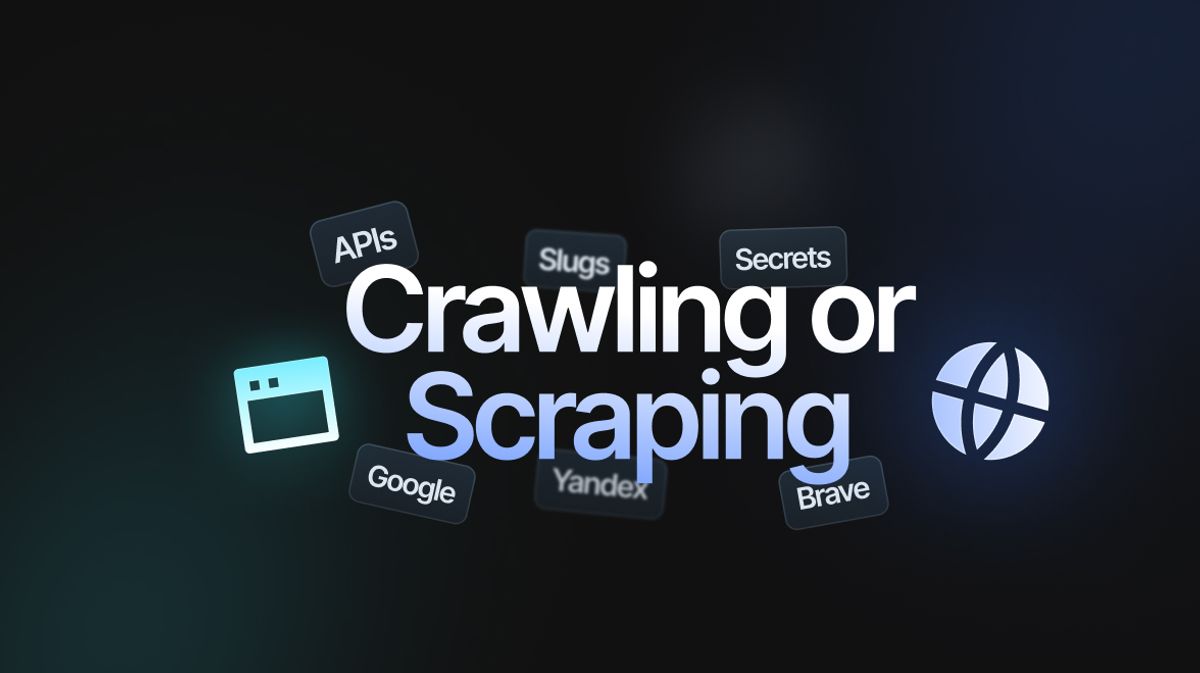
A web crawler and a search engine scraper can both produce lists of URLs, but they solve different discovery problems. A search engine scraper works from the outside in: it collects pages that search engines already know about. A web crawler works from the inside out: it starts with a website and follows reachable links to map the site more deeply.
The short answer
Use a search engine scraper when you need broad discovery across many domains, queries, countries, or search engines. Use a web crawler when you already have an authorized website or seed URL and need deeper coverage inside that target. In many professional workflows, the best answer is to use both in sequence.
What is a search engine scraper?
A search engine scraper submits keywords or structured queries to search engines and collects result URLs, titles, snippets, and related metadata. In security research or OSINT, it can turn large dork lists into targeted seed URLs without manually reviewing every results page.
- Starts with keywords, dorks, domains, or topic-based queries.
- Discovers URLs already present in one or more search-engine indexes.
- Works well for broad, multi-domain, regional, and multilingual discovery.
- Its coverage is limited by what each search engine has indexed and chooses to return.
This differs from a generic web scraper, which normally visits known pages to extract structured data such as prices, tables, or product details. A search engine scraper is primarily a discovery tool.
What is a web crawler?
A web crawler starts from one or more seed URLs, downloads permitted pages, extracts links, and continues following them according to its scope and rules. It builds a map of reachable content on a specific site or approved set of sites.
- Starts with a known URL or authorized domain.
- Can discover internally linked pages that are missing from search results.
- Provides deeper coverage of one website, application, or defined scope.
- May need JavaScript rendering to map single-page applications accurately.
A crawler does not depend on Google or Bing having indexed a page. However, it can only reach content exposed through links, routes, sitemaps, scripts, or other discoverable paths inside its configured scope.
Web crawler vs search engine scraper: key differences
Direction of discovery
A search engine scraper moves from external indexes toward candidate websites. A crawler begins inside a selected website and expands through its link graph. Think of the scraper as finding neighborhoods and the crawler as walking every permitted street.
Breadth versus depth
Search engine scraping prioritizes breadth across many domains. Crawling prioritizes depth and internal relationships within a smaller number of authorized targets.
Indexed versus unindexed content
A scraper sees what search engines expose. A crawler may reach public but unindexed internal pages, newly published pages, and routes linked by scripts.
JavaScript-heavy applications
Search results reveal only URLs that an engine successfully processed. A crawler designed for SSR, SPA, and static architectures can handle modern routing and extract links produced after JavaScript execution.
Typical output
A search engine scraper usually returns deduplicated URLs with search metadata. A crawler adds discovered pages, link relationships, response information, and sometimes parameters or assets.
Limits and responsibilities
Both tools must respect authorization, applicable law, rate limits, platform rules, and target stability. Finding a URL does not grant permission to access restricted content or test it for vulnerabilities.
When should you use each tool?
- Choose the scraper for initial seed lists, multi-engine research, geographic coverage, and broad public-web discovery.
- Choose the crawler for internal navigation, parameters, forms, JavaScript routes, and deeper mapping of an authorized target.
- Use both when you need external discovery followed by controlled, in-scope depth.
A combined discovery workflow
- Run approved queries through the search engine scraper to collect candidate URLs.
- Normalize and deduplicate the results, then confirm which domains are in scope.
- Use selected in-scope URLs as seeds for the web crawler.
- Review newly discovered routes and remove anything outside the authorization boundary.
- Send only validated, permitted URLs into later categorization or security testing.
How the workflow fits into DorkPlus
DorkPlus separates the jobs into dedicated modules. Search Engine Scraper can process dorks across 24 search engines, including a proxyless Google Advanced engine, to create broad link lists. Web Crawler supports SSR, SPA, and static sites so those lists can be expanded inside authorized targets.
Flow System can connect the modules into a repeatable pipeline: Scraper → deduplication and scope review → Crawler → Categorizer or Vulnerability Scanner. Human review should remain the gate between discovery and active testing.
Common mistakes to avoid
- Calling every URL collection tool a crawler and assuming the outputs are interchangeable.
- Crawling every scraped domain without confirming ownership, permission, and scope.
- Expecting a search engine scraper to find pages that were never indexed.
- Expecting a crawler to discover disconnected content with no reachable route or seed.
- Maximizing speed without rate controls, stability checks, or a clear research purpose.
Frequently asked questions
Is a search engine scraper the same as a web scraper?
Not exactly. A search engine scraper collects search results, usually to discover URLs. A general web scraper extracts selected data from known pages. Some tools combine both behaviors, but their goals and starting inputs differ.
Can a crawler find every page on a website?
No. Coverage depends on starting seeds, link structure, JavaScript rendering, authentication, scope rules, and server behavior. A crawler maps what it can legitimately reach, not every possible route.
Do I need both tools?
Not for every task. Broad research may need only a search engine scraper, while a focused site audit may begin directly with a crawler. Use both when you need external discovery followed by deep, authorized mapping.
Conclusion
Choose the tool based on the question. If you need to find relevant sites and pages across the web, start with a search engine scraper. If you need to understand what is reachable inside an authorized website, start with a crawler. When breadth and depth both matter, combine them with an explicit scope checkpoint between stages.
Shop nowThe blog posts on this website are fictional and theoretical. They exist for educational purposes only and should never be treated as instructions to perform illegal or unauthorized activities.
The scenarios described are hypothetical and do not promote or encourage malicious or harmful actions. They reflect a professional penetration tester's perspective, assuming proper permission and legal authorization to test a website, company, or network.
Our posts are not a call to action, and we do not condone illegal activity. Readers are responsible for complying with applicable laws and regulations.
By reading our posts, you acknowledge these terms. If you are not a professional or authorized individual, do not attempt to replicate any techniques described here.
Our content is for education only, and we strongly advise against using any information or techniques for malicious purposes.
Read next
Google Dorks for OSINT: An Advanced Research Guide
SQL Injection Methods Explained: Time, Boolean, Error, Union and More
MD5, SHA1, SHA256 Hash Cracking: Complete Guide for Pentesters
Google Dork Operators Cheat Sheet 2026: The Complete Guide
Credential Stuffing and AntiPublic Checkers: What Security Professionals Need to Know
Is Google Dorking And SQLi Dead In 2026?

DorkPlus has been around for over three years. It started as a Google proxyless scraper and grew into an all-in-one pentesting solution, evolving week after week.
Copyright © 2026 DorkPlus
All systems operational